


What is an Industrial Data Historian? (And Why It Matters in 2026)
If you’ve spent time in a process plant, refinery, or manufacturing facility, you’ve probably heard someone mention “the historian.” Maybe it came up during troubleshooting, or when someone needed to pull data from last month’s production run.
But what is an industrial data historian exactly, and why do plant engineers rely on it so heavily?
This guide explains what an industrial data historian is, how it works, and why it remains essential infrastructure in 2026—even as cloud platforms and new time-series databases compete for attention.
Whether you’re evaluating a new deployment, modernising an existing system, or understanding operational data flows, this article provides the complete picture.
Key Takeaways
- Industrial data historians efficiently capture, compress, and store massive volumes of time-stamped industrial data.
- They provide fast access for troubleshooting, process optimisation, predictive maintenance, and regulatory compliance.
- Modern historians integrate with cloud platforms, AI/ML workflows, and enterprise systems to support digital transformation.
- Choosing the right historian requires balancing scalability, integration, and operational ease to meet current and future industrial needs.
What is an Industrial Data Historian?
An industrial data historian is specialised data management software designed to collect, compress, store, and retrieve time-series data from vast amounts of time-stamped data generated by industrial equipment and control systems.
Unlike traditional data historian databases built for business transactions, a historian is a specialised system optimised for continuous streams of process data, including:
- Temperatures
- Pressures
- flow rates
- Valve positions
- Motor speeds
- Other measurements that define how a plant operates.
Every second, a typical process plant generates enormous quantities of data points from sensors, programmable logic controllers (PLCs), distributed control systems (DCS), and SCADA systems.
A historian captures all of this, compresses it efficiently, and makes it available for data analysis years or even decades later.
When a process engineer needs to understand why a compressor tripped last Tuesday at 3:47 AM, the historian provides that answer while preserving data integrity.
These products became a foundational data infrastructure in industrial environments worldwide.
For example, tracking a compressor’s discharge pressure every second, 24 hours a day, 365 days a year, generates over 315 million data points per decade for that single measurement.
A data historian is like a memory for your plant. It captures everything machines do, stores it safely, and lets you analyse it to improve performance, prevent problems, and make data-driven decisions.
Industrial vs Generic Databases
Not all time series data databases are created equal. Understanding the differences between industrial data historians and generic alternatives helps explain why purpose-built solutions remain dominant in process industries.
|
Aspect |
Industrial Data Historians |
Generic Time Series Databases |
|
Data collection |
Native drivers for PLCs, DCS, and SCADA systems |
Requires custom middleware or gateways |
|
Compression |
90-95% compression via specialised algorithms |
Standard compression, typically lower ratios |
|
Tag counts |
Routinely handles hundreds of thousands to millions |
May require more infrastructure to match |
|
Process control systems integration |
Built-in OPC UA, Modbus, proprietary protocols |
Requires custom connectors for industrial control systems |
|
Query latency |
Sub-second retrieval across decades of historical data |
Optimised for recent data, slower for large volumes |
|
Operational data focus |
Engineered for industrial processes and process variables |
Designed for IT metrics, web apps, and general IoT |
|
Data integrity |
Mission-critical features for industrial settings |
General-purpose reliability |
Industrial data historians are tightly integrated with operational technology (OT) systems. They speak native languages of the plant floor—OPC Classic, OPC UA, Modbus, and proprietary protocols from automation vendors.
They’re designed for industrial environments: noisy signals, intermittent connectivity, and an absolute requirement for data integrity when production or safety is on the line.
Generic time-series databases like InfluxDB or TimescaleDB excel at IT-oriented metrics but weren’t designed for control-system integration. Connecting them to a DCS or PLC typically requires custom middleware, making industrial historians the practical choice for process engineers managing industrial operations.
Core Functions of an Industrial Data Historian
An industrial data historian sits between plant floor systems and higher-level applications, consuming operational data.
It serves as the central data source where process control systems deposit measurements and where MES, ERP, advanced analytics, and engineering tools retrieve data for analysis.
Architecture and Data Flow
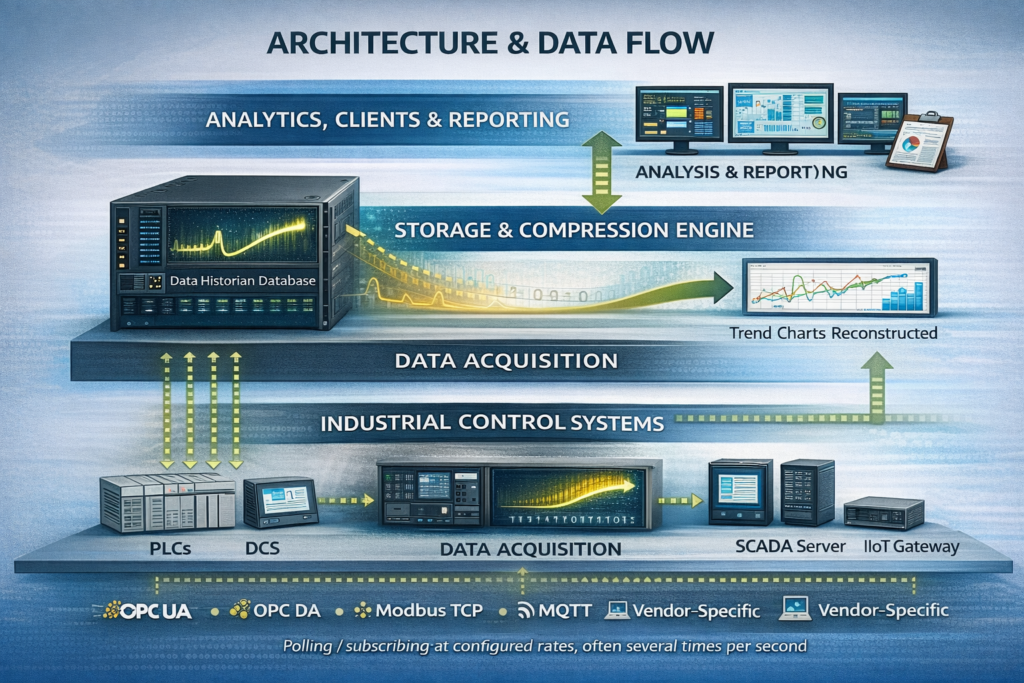
The system uses a layered design. At the base, data is collected directly from industrial control systems such as PLCs, DCS, SCADA servers, and, increasingly, IIoT gateways.
These devices communicate via protocols such as OPC UA, OPC DA, Modbus TCP, MQTT, or vendor-specific drivers, and collect data multiple times per second for critical measurements.
Once collected, the data is stored efficiently using special compression methods. Instead of storing every value, the historian retains the key trends while reducing storage requirements.
For example, if a temperature remains steady at 150°C, the system doesn’t store that value thousands of times; it still lets you recreate full trend charts when needed.
Core Capabilities
Industrial data historians provide essential capabilities for managing data from industrial processes:
- Data Acquisition: Continuous collection from PLCs, DCS, SCADA, and IIoT devices via industrial protocols.
- Efficient Storage: Time-series storage with 90–95% compression for large-scale data.
- Fast Retrieval: Sub-second access to years of historical data for informed decision making.
- Integration: APIs, ODBC/JDBC, SQL gateways, and SDKs for seamless analytics and digital transformation.
- Event Capture: Logs of process events, alarms, and batch records alongside analogue and digital data for compliance.
Use Cases Across Industries
Industrial data historians are ubiquitous across process and discrete manufacturing. Most large plants installed some form of historian between 1990 and 2010, and these systems remain the operational backbone for data-driven decision-making.
Applications by Industry
|
Industry |
Key Applications |
Data Types |
Business Value |
|
Manufacturing & Process Industries |
OEE tracking, throughput analysis, process optimisation, batch tracking |
Production data, analogue data, quality metrics |
Enhancing process efficiency, equipment effectiveness, reduced scrap |
|
Oil & Gas / Power Generation |
Wellhead monitoring, compressor health, turbine performance, flare minimisation |
Pressures, temperatures, vibration data, emissions |
Operational efficiency, predictive maintenance, and regulatory compliance |
|
Utilities & Water |
Supervisory control, load forecasting, asset health monitoring, quality compliance |
Flow rates, energy consumption, treatment parameters |
Optimise operations, maintenance scheduling, and compliance reporting |
|
Pharmaceuticals |
Batch genealogy, process validation, and regulatory compliance documentation |
Process variables, event data, quality records |
Traceability, audit support, and FDA 21 CFR Part 11 compliance |
|
Chemicals & Refining |
Golden batch analysis, changeover optimisation, process optimisation |
Reactor data, feed rates, process variables |
Process efficiency, quality improvement, yield optimisation |
Manufacturing and Process Industries
In sectors like chemicals, refining, food and beverage, and pharmaceuticals, historians support everything from basic troubleshooting to sophisticated process optimisation initiatives.
Consider a chemical plant that has correlated reactor temperature profiles with product quality certificates over the past decade.
The historian provides a complete record—every temperature reading, every batch parameter —enabling engineers to identify anomalies and conditions that produce optimal outcomes.
Process engineers use historian data for:
- OEE tracking (Overall Equipment Effectiveness)
- identifying bottlenecks using production data trends
- batch tracking
- maintaining complete genealogy for regulatory compliance
This supports enhancing process efficiency and operational performance across manufacturing processes.
Energy and Critical Infrastructure
The oil and gas sector relies heavily on historical data for safety, reliability, and regulatory compliance.
A 500 MW combined-cycle power generation plant might use its historian to continuously monitor turbine exhaust temperatures, bearing vibrations, and emissions levels. When a trip occurs, the historian provides detailed records needed to diagnose causes and prevent recurrence.
Utilities connect historians to SCADA systems monitoring distribution networks spanning hundreds of square miles.
The historian becomes the single source of truth for network status, demand patterns, and asset health, enabling supervisory control and improving operational efficiency.
Key Benefits of Using an Industrial Data Historian
Industrial data historians are now mission-critical because they solve plant-floor challenges that generic IT systems can’t.
Reliability and Performance
Industrial historians are engineered to run continuously in demanding industrial settings. Uptime expectations of 99.9% or higher are standard, and many facilities run the same historian infrastructure for 15-20 years with minimal interruption.
These systems handle bursts of data generated during plant startups, shutdowns, and upsets without data loss.
Built-in buffering and store-and-forward capabilities ensure that network outages don’t cause gaps in historical data, preserving data fidelity.
Efficient Data Management at Scale
Compression capabilities enable efficient storage of vast quantities of process data that would be impractical with conventional databases.
Realistic compression ratios of 90-95% mean that measurements recorded every second for ten years occupy only a fraction of the storage required for the raw data. Historians organise data into tags (named data points), archives, and tiered storage systems.
Recent data stays on fast storage for immediate insights, while older data moves to economical media—all remaining queryable through the same interface, reducing storage costs while supporting large volumes of time series data from industrial sources.
Seamless Integration with Industrial Control Systems
Industrial data historians serve as a central hub for collecting and sharing process data across the plant and enterprise.
Plant-Floor Connections:
- Connects directly to PLCs, DCS, SCADA, and safety systems.
- Uses vendor-specific interfaces and standard protocols like OPC UA.
- Pre-built connectors reduce integration time and risk compared with building custom pipelines.
Enterprise Integration:
- Works with MES, LIMS, CMMS, and ERP systems.
- Supports REST APIs, ODBC/JDBC connections, and MQTT for seamless data exchange.
- Enables automated production reports, quality records, and business analytics.
- Aggregates data from multiple sources, eliminating manual data collection.
By bridging plant-floor operations with enterprise systems, industrial data historians make data more accessible, actionable, and ready to drive smarter decisions.
Advanced Analytics and Predictive Maintenance
Industrial historians provide the foundation for condition-based and predictive maintenance by storing long-term equipment performance data. Key capabilities include:
- Data Access for Equipment Health: Engineers and data scientists can retrieve information on bearing temperatures, motor currents, vibration patterns, and hundreds of other parameters.
- Support for AI and Machine Learning: High-quality historian data powers anomaly detection models, failure prediction algorithms, and digital twin applications. Generates actionable insights that optimise operations and improve efficiency across industrial systems.
Compliance and Audit Trails
In regulated industries like pharmaceuticals (FDA 21 CFR Part 11), food and beverage, and power generation, historians provide tamper-evident, time-stamped data records required for regulatory compliance.
These systems support electronic signatures, access control, and comprehensive change logs, ensuring data integrity for audits and investigations throughout manufacturing processes.
Limitations of Industrial Data Historian
While industrial data historians have delivered tremendous value, traditional data historian architectures designed in the 1990s and 2000s face challenges in 2026.
Understanding these limitations informs modernisation strategies for operational historians.
- Scalability: Legacy historians were designed for thousands of tags, but modern IIoT environments generate millions of high-frequency data points, often requiring costly hardware upgrades or multiple instances.
- Integration with Modern Analytics: Proprietary formats make connecting to cloud platforms and AI tools difficult, often requiring batch exports or custom connectors, which adds latency and maintenance overhead.
- Cost and Flexibility: Tag- or server-based licensing, specialised hardware, and maintenance contracts drive up costs, while configuration changes often require vendor support, limiting self-service access.
Modern industrial data historians combine on-premises reliability with cloud flexibility. That is why it’s important to be aware of these limitations for a smoother collection and utilisation of historical data.
Selecting and Modernising Your Historian
When evaluating historian solutions, consider both immediate requirements and future needs supporting AI/ML initiatives, IIoT expansion, and evolving regulatory compliance requirements through 2030 and beyond.
Key Evaluation Criteria
- Technical Factors: supported protocols (OPC UA, Modbus, MQTT), data throughput, signal compression efficiency, query speed, and uptime options.
- Integration: Available APIs (REST, SQL, OPC UA), cloud connectors (Azure, AWS, GCP), data lake support, and compatibility with containerised deployments.
- Operational Considerations: How easy it is to manage and monitor, backup and disaster recovery, cybersecurity certifications, and the quality of vendor support.
Migration Strategies
Many plants run historians in production for 10-20 years, accumulating irreplaceable historical data. Migration requires careful planning to maintain continuity and preserve data fidelity.
Strategies include running old and new systems in parallel, data mirroring to validate accuracy, historical data backfill using specialised tools, gradual client migration, and validation testing to verify calculations and regulatory compliance reports after migration.
Need assistance with your historian? Talk to our team.
Industrial Data Historians Are Essentials in 2026
Industrial data historians remain central to capturing operational history and turning raw data into actionable insights. Modern systems combine on-premises reliability with cloud and analytics-ready architectures, supporting AI/ML, predictive maintenance, and process optimisation.
The real question is when you start implementing industrial data historians to make smarter, data-driven decisions for the next decade.
Take Action Today and partner with Allied Solutions to assess, modernise, or deploy a historian system that transforms your operational data into measurable business value.