



What is an MES System? Key Benefits for Modern Manufacturing Operations
If you’ve watched a production line halt because of missing components, or spent hours tracing quality defects through paper records, you understand the problem that MES solves.
A Manufacturing Execution System (MES) sits at the heart of modern manufacturing operations, connecting high-level business planning to what’s happening on your shop floor.
It turns production plans into executed production orders, captures every detail, and gives you visibility for faster decisions.
This guide explains the key benefits of MES systems for modern manufacturing operations, how they fit into existing systems, and why manufacturers treat them as foundational technology for competing today.
Key Takeways
- An MES system bridges the gap between business planning and shop-floor execution, ensuring production runs as planned.
- It provides real-time visibility, traceability, and quality control that paper-based processes cannot match.
- Manufacturers use MES to improve efficiency, reduce waste, meet regulatory requirements, and support Industry 4.0 initiatives.
- When implemented correctly, MES delivers measurable operational and financial benefits within the first few years.
What is an MES System?
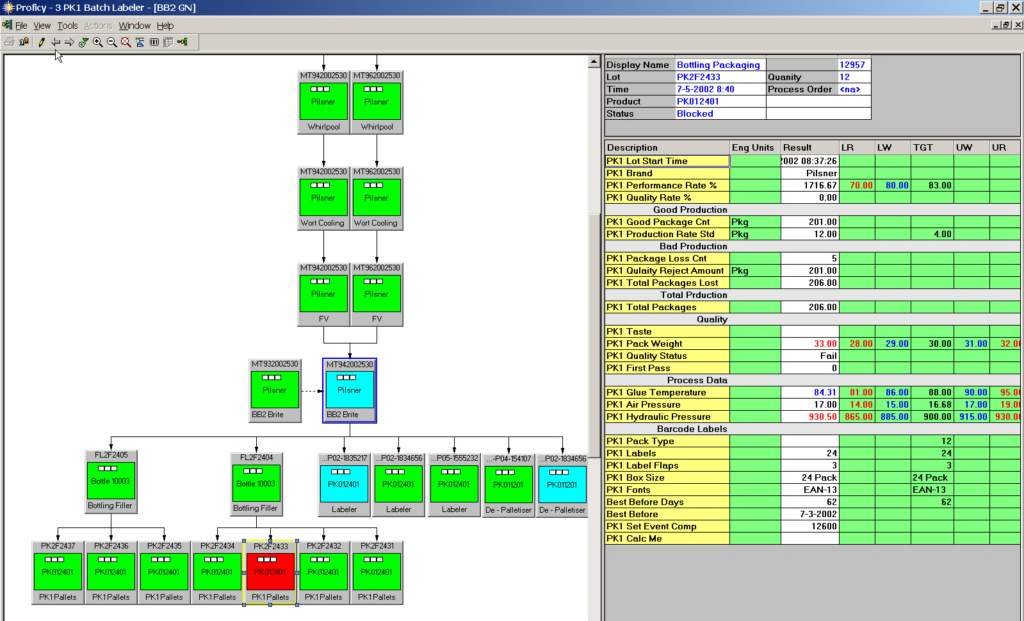
A Manufacturing Execution System (MES) is Level 3 software in the ISA-95 model that controls, monitors, and documents production processes in real time. It sits between your enterprise resource planning (ERP) system at Level 4 and plant control systems—PLCs, SCADA, DCS—at Levels 0-2.
It is the operational brain that translates what the business wants into how the shop floor executes it.
MES tracks the entire manufacturing process: from raw materials arriving, through work-in-progress on the factory floor, to finished products leaving the line.
It includes the MES System software, integrations with other systems, data model, and digital workflows operators use on the plant floor.
Key characteristics:
- Real-time execution control: MES actively manages what’s happening now, dispatching orders, enforcing quality control checks, and capturing production data as production runs
- Production traceability: Every unit gets tracked through every operation, connecting finished products to specific raw materials lots, equipment, operators, and process control parameters
- Bidirectional integration: MES receives production orders and bills of materials from ERP, sends back actuals—production counts, scrap, resource usage, supporting data-driven decision making
- Industry-wide adoption: Automotive plants use MES to manage production, pharmaceutical facilities rely on it for batch records, and food producers track allergens
How MES Fits Into the Manufacturing Tech Stack
MES operates between business systems, such as ERP, and real-time control systems. It takes high-level production plans and translates them into executable shop-floor operations, including detailed schedules, work sequences, and operator assignments.
MES vs Other Systems
|
System |
Primary Role |
Time Horizon |
Data Granularity |
|
ERP Systems |
Business operations, supply chain management |
Days/weeks |
Order/batch level |
|
Manufacturing Execution System MES |
Shop floor operations execution |
Seconds/minutes/hours |
Machine/operation/unit |
|
Process Control Systems |
Direct equipment control |
Milliseconds/seconds |
Sensor/actuator level |
|
CMMS |
Maintenance management |
Days/weeks |
Equipment level |
Integration flows:
- Enterprise Resource Planning ERP to MES: Production orders, bills of materials flow down; MES breaks these into detailed work orders
- MES to ERP: Actuals flow back—completed quantities, scrap, material consumption for supply chain management
- Control systems to MES: Machine signals, cycle times, feed production data for overall equipment effectiveness calculations
- MES to CMMS: Equipment events and downtime collected data flow to maintenance management systems
Modern MES solutions expose APIs, support OPC-UA connectivity for data collection, and include MQTT links for smart factory analytics and digital transformation.
Core Functions of an MES System
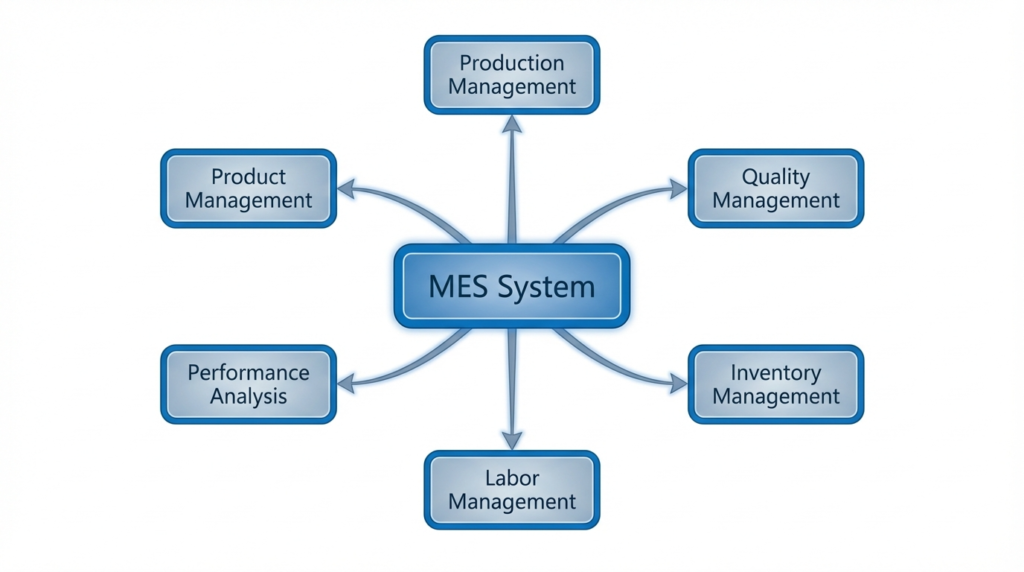
MES capabilities address specific challenges in manufacturing operations management.
Production Planning and Dispatching
MES handles detailed finite scheduling beyond what ERP can do. While ERP systems might plan a 500-unit order, MES determines which lines run which quantities and in what sequence to optimise production efficiency.
Electronic dispatch lists show operators exactly what to produce next based on real-time data. When machines go down or rush orders arrive, MES automatically resequences work across the production floor within minutes.
Work-in-Progress Tracking and Genealogy
MES builds a complete production traceability genealogy that connects finished products to specific raw material lots, equipment used, operators, and process control parameters. This tracking happens automatically through barcode scans and RFID reads.
The result: trace from finished product to all inputs, or from suspect raw materials to every finished product.
Through this process, every unit moving through your manufacturing process gets tracked by lot number and route step.
Quality Management and Process Control
Quality control is directly integrated into production processes. The system enforces inspection plans, presents electronic checklists, and captures measurement results for SPC data analysis in quality management.
When quality control checks fail, MES automatically holds affected lots, preventing them from moving downstream. This early detection dramatically reduces waste and quality costs, ensuring product quality throughout the entire manufacturing process.
Performance Management
MES calculates overall equipment effectiveness in real time, breaking down availability, performance, and quality losses for every machine.
Supervisors see dashboards that show current OEE, with drill-down capability to identify where losses occur, enabling performance analysis and data-driven decision-making across shop-floor operations.
Key Benefits for Modern MES System
In 2025, MES became foundational for Industry 4.0 and smart factory programs. When properly implemented, manufacturers see measurable ROI within 12-36 months.
Key Benefits Summary
|
Benefit |
Typical Improvements |
Business Value |
|
Visibility & Control |
Instant real-time insights |
Faster decision makers response |
|
Production Efficiency |
5-15% OEE improvement |
Increased output without capacity additions |
|
Quality Assurance |
20-40% defect reduction |
Lower warranty costs, better quality management |
|
Waste Reduction |
15-30% scrap reduction |
Lower raw materials costs, sustainability |
|
Compliance |
50%+ less audit prep time |
Meets strict regulations, industry regulations |
Real-Time Visibility and Control
Supervisors can view the live status of every line, order, and machine on dashboards that update every few seconds with real-time data. No more walking the factory floor to check jobs or waiting until shift end to learn about problems affecting manufacturing performance.
This visibility extends from the production floor to the executive offices. Role-based dashboards enable everyone to access real-time insights for data-driven decision-making, improving business operations across the modern manufacturing organisation.
Higher Equipment Effectiveness
Automatic downtime tracking provides the data needed to systematically assess equipment effectiveness. Manufacturers commonly report overall equipment effectiveness improvements of 5-15 percentage points within the first year, directly improving production efficiency.
When you identify exactly where time is lost (e.g., from changeovers, stops, speed losses, defects), you prioritise efforts to have the greatest impact on manufacturing performance and production efficiency across the shop floor.
Improved Quality and Traceability
Full genealogy enables rapid root-cause data analysis.
If customer complaints come in, you trace back through the entire manufacturing process to identify which raw materials, lots, equipment, and process control conditions were involved—essential for production traceability and quality assurance.
This is critical in the pharmaceutical, medical device, and food & beverage industries. With MES, you limit recalls to precisely affected lots rather than entire product lines, protecting product quality.
Reduced Waste
Early defect detection and process control enforcement significantly reduce material loss. When MES prevents out-of-spec lots from continuing downstream, you avoid adding labour and materials to products that will be scrapped. This reduces waste of materials, energy, labour, and machine time.
Environmental and cost benefits compound over time, supporting sustainability in the digital world while improving production efficiency.
Paperless Operations
MES eliminates paper travellers and manual logbooks. Operators access digital work instructions on the paperless shop floor, always seeing current revisions, reducing human error and improving document control.
This paperless shop floor approach improves data integrity, reduces transcription errors, and supports digital transformation by dramatically reducing paper consumption across manufacturing operations.
Regulatory Compliance
For regulated industries, MES provides electronic batch records and audit trails required by regulations such as FDA 21 CFR Part 11.
Instead of scrambling to compile paper records, you retrieve complete document control records in minutes—essential for regulatory compliance.
The system automatically enforces validated business processes and captures electronic signatures, reducing compliance risk and supporting quality management in regulated goods manufacturing.
Better Decision-Making
MES collects historical data that becomes increasingly valuable over time. Combined with real-time insights, this production data supports analysis for continuous improvement, predictive maintenance, and strategic planning, enabling decision-makers to make informed decisions.
Dashboards let plant managers drill down from KPIs to specific events, identifying patterns invisible with manual data collection. As a result, it transforms manufacturing operations management through data-driven decision-making.
MES Across Industries
MES has been adopted across discrete, batch, and continuous manufacturing since the 1990s. The global MES market is projected to grow over 10% annually, driven by digital transformation and increasing industry regulations.
- Automotive: If recalls are issued, MES production traceability identifies exactly which vehicles received defective components, limiting recalls to specific VINs.
- Pharmaceuticals: MES provides electronic batch records that capture every material addition and equipment parameter to ensure compliance.
- Food & Beverage: MES tracks ingredients through the entire manufacturing process, flagging contamination risks.
- Electronics: MES allows tracing every component, identifying which finished products they entered, and determining which customers received affected units—all within hours.
MES and Smart Factory Initiatives
Industry 4.0 envisions highly connected, data-driven manufacturing operations. MES serves as the backbone, making smart factory visions practical and enabling advanced technologies that transform shop-floor operations.
Modern manufacturing implementations enable capabilities beyond basic execution:
- Digital Twins: MES timestamps operations and captures process control parameters, creating a production data foundation for digital twins mirroring real-time plant behaviour
- Advanced Analytics: Machine learning trained on MES production data predicts equipment failures before downtime, supporting production efficiency
- Augmented Reality and Virtual Reality: Augmented reality overlays display MES instructions in operators’ field of view; virtual reality training simulates MES workflows, supporting digital transformation
- Closed-Loop Quality: MES quality results automatically feed back to process control systems, adjusting setpoints without human intervention
Implementation Considerations on MES Systems
MES projects are business transformations requiring 9-24 months from kickoff to production use. Success requires clear objectives, strong change management, and realistic expectations.
Implementation steps:
- Define Objectives: Set specific goals like “reduce scrap from 4% to 2.5% within 12 months”
- Map Processes: Document as-is workflows, existing systems, integration points
- Select Architecture: Consider on-premise, cloud, or hybrid; confirm ISA-95 and OPC-UA support
- Start with Pilot: Begin with a single line rather than a big-bang rollout
- Change Management: Involve operators early, develop role-based training
- Measure and Optimise: Monitor KPIs for 6-12 months before extending to additional lines
MES System Gives You Full Control
If your operation relies heavily on paper, struggles with quality escapes, lacks real-time performance visibility, or faces audit challenges, MES provides the execution layer you need to regain control.
An MES system bridges the gap between ERP and shop-floor control, ensuring production plans are executed accurately. With MES, manufacturers gain full visibility, reduce waste, improve efficiency, and maintain regulatory compliance.
If you’re ready to transform your shop floor and turn production data into a competitive advantage, Allied Solutions can help you take the first step. Contact us today.