If you run a production line in Singapore, Ho Chi Minh City, Hanoi, or anywhere else in Southeast Asia, you have already heard the three letters: OEE. Overall Equipment Effectiveness is the headline KPI of modern manufacturing — quoted by your customers, demanded by your group office, and printed on every executive dashboard at every trade show from ProPak Vietnam to ITAP Singapore.
The problem is that most factories in the region either don’t calculate OEE at all, or calculate it inconsistently across lines, shifts, and plants. A line manager in Bình Dương records downtime in a notebook; the planner in Tuas exports a SCADA CSV every Monday morning; the group reporting team in Singapore builds a Power BI dashboard on top of both — and the numbers don’t reconcile. Without a single, real-time source of truth, OEE becomes a debate instead of a decision tool.
This guide gives you the exact OEE formula — the same one published by Parsec Automation, the developer of the TrakSYS MES platform — a worked example with realistic numbers, the benchmarks Parsec cites for what “world-class” actually looks like, and a practical view of how an MES like TrakSYS automates OEE end-to-end. We’ll keep the framing local: examples are sized for a typical Singapore electronics plant or a Vietnamese F&B line, and every claim is grounded in vendor documentation, not assumption.

What is OEE?
OEE stands for Overall Equipment Effectiveness. Parsec’s own definition puts it cleanly:
“OEE measures the overall effectiveness of a piece of manufacturing equipment on a scale of 1-100, with 100 representing total production utilization with zero downtime.” — Parsec Automation, “What is OEE in Manufacturing?”
An OEE of 100 means the equipment ran every available minute, at its rated speed, producing only good parts. It is a theoretical maximum nobody actually hits — but it gives you an honest yardstick. A line running at 60% OEE is leaving roughly 40% of its potential capacity on the floor, somewhere in the trio of Availability, Performance, and Quality. The job of an OEE programme is to find out which one, and why.
OEE matters in Southeast Asia specifically because the region’s factories operate under a particular set of pressures: high SKU complexity, frequent changeovers, multi-language workforces, mixed-vendor automation stacks, and increasingly tight regulatory and customer-quality requirements. The same line in Singapore that produces medical-device assemblies for the EU market shares its OEE methodology with sister sites in Vietnam producing for the Japan market. If the methodology drifts, the numbers stop being comparable — and the whole point of OEE is that it should be comparable across line, shift, plant, and country.
The OEE formula
OEE is the product of three independent factors, each scored 0-100%:
OEE = Availability × Performance × Quality
Each factor isolates one type of loss, so once you know the OEE number you can also point to where the loss is happening. Here are the three formulas exactly as Parsec defines them in their TrakSYS documentation:
1. Availability
Availability = (Operating Time ÷ Planned Production Time) × 100
Availability captures the percentage of scheduled production time that the equipment was actually running. It includes both planned events (changeovers, scheduled maintenance, cleaning, sanitation washes) and unplanned events (breakdowns, material shortages, operator absence, power dips). A line scheduled for 480 minutes that ran 360 minutes has 75% availability — regardless of why the other 120 minutes were lost.
Important: Availability is measured against Planned Production Time, not the full shift clock. If a 480-minute shift includes 30 minutes of planned breaks and 30 minutes of planned changeover, the Planned Production Time is 420 minutes. Mixing this up is one of the most common reasons OEE numbers fail to reconcile between line teams and group reporting.
2. Performance
Performance = (Ideal Cycle Time ÷ Actual Cycle Time) × 100
Performance captures speed losses — the gap between how fast the machine should run and how fast it did run while it was running. Per Parsec’s OEE primer, performance losses come from “minor stops (jams, incorrect settings) and sub-optimal speeds due to inadequate maintenance or inefficient operation.”
Performance does not include downtime; downtime already lives in Availability. What it captures is micro-stoppages (a one-second pause every minute), reduced-rate running (operator dialled the line speed down because of upstream feed issues), and equipment wearing slower than the design spec. In packaging lines in Vietnamese F&B plants we routinely see Performance below 85% even when Availability looks healthy — usually a sign of upstream feed instability.
3. Quality
Quality = (Quality Units ÷ Total Units) × 100
Quality is the percentage of units produced that passed first-time, with no rework. Scrap, rework, and second-grade product all hurt the Quality factor. This is the OEE factor regulated industries pay the closest attention to: in Singapore pharma or Vietnamese seafood processing, a 2-percentage-point Quality loss can mean an entire batch is unsaleable.
The trick in Quality measurement is to count real quality, not nominal yield. A line that produced 10,000 units, of which 9,800 passed final inspection but 200 went through rework before passing, should report Quality of 9,800 / 10,000 = 98% — not 100%. The cost of rework is a real loss, even if the unit eventually ships.
A worked OEE example
Numbers make this real. Take a single 8-hour shift on a bottling line at a typical Vietnamese beverage plant:
- Shift duration: 8 hours = 480 minutes
- Planned breaks + meetings: 30 minutes
- Planned Production Time: 450 minutes
- Downtime during the shift (a 40-minute changeover overrun + 20 minutes for a jam clearance): 60 minutes
- Operating Time: 450 − 60 = 390 minutes
- Design speed (Ideal Cycle Time): 60 bottles per minute = 1 second per bottle
- Total bottles produced during Operating Time: 19,500
- Bottles failing the final reject station (cap defects + fill weight out of spec): 195
Now apply the three formulas:
- Availability = 390 / 450 = 86.7%
- Theoretical maximum bottles in 390 minutes at 60 bpm = 23,400. Actual = 19,500.
Performance = 19,500 / 23,400 = 83.3%
- Good bottles = 19,500 − 195 = 19,305.
Quality = 19,305 / 19,500 = 99.0%
- OEE = 0.867 × 0.833 × 0.990 = 71.5%
71.5% is a respectable number for a single shift on a real line. It also tells you exactly where to look first: Performance is the worst factor, so the next investigation should focus on micro-stoppages and feed instability — not on chasing the last 1% of Quality, which is already near-perfect.
This is the practical value of OEE. The composite number alone is just a scoreboard. The three sub-factors tell you where to invest the next improvement hour.
Industry benchmarks: what is “world-class” OEE?
Parsec publishes the same benchmarks that have become standard across the OEE literature:
- Perfect production: 100% — the theoretical ceiling, never achieved in practice
- World-class: ~85% — the realistic target for a well-run discrete or batch line
- Typical manufacturing: ~60% — the median real-world OEE Parsec reports across deployments
The 60% typical figure surprises people the first time they see it. A factory manager who has never measured OEE rigorously often guesses that the lines run at 80-85%. When the data finally arrives — accurate, real-time, and unfiltered by shift handoff politics — the actual number is often in the high 50s or low 60s. This is not because the operations team is bad; it is because the micro-stoppages, speed losses, and quality rework nobody was counting add up to a much larger number than anyone expected.
The Singapore Smart Industry Readiness Index (SIRI), which the EDB-backed assessment programme uses to score local manufacturers, treats consistent OEE measurement as a foundational dimension of digital maturity. In Vietnam, the Ministry of Industry & Trade’s Industry 4.0 framework similarly puts production-data visibility — of which OEE is the headline KPI — at the centre of the “Smart Factory” tier. In both countries, a plant that can demonstrate ongoing OEE improvement on real data carries weight with both regulators and customers.
Common pitfalls when calculating OEE manually
Most SEA plants start their OEE journey in Excel, with operators logging downtime in a notebook and a junior engineer typing the numbers up every morning. This works as a proof of concept — but it breaks at scale, and almost every plant we visit has hit at least three of these pitfalls:
Pitfall 1: Inconsistent definition of “planned” vs “unplanned” downtime
A changeover that overran by 15 minutes — is the overrun planned (because the changeover was scheduled) or unplanned (because it took longer than the standard)? Different shifts answer this differently, and the resulting OEE numbers stop being comparable.
Pitfall 2: Counting product, not parts
On a multi-cavity moulding machine producing 8 parts per cycle, the Performance calculation needs to use the cycle and the part count — not just the cycle. Plants that count cycles instead of parts systematically under-report Performance.
Pitfall 3: Ignoring micro-stoppages
A jam that clears itself in 30 seconds typically never makes it into the operator’s downtime log — but on a high-speed line, 30 seconds repeated 20 times in a shift is 10 minutes of lost Availability. Manual logging misses these almost completely.
Pitfall 4: Quality measured at final inspection only
If your Quality factor uses final-inspection pass rate, you miss the units that went through rework and passed on the second attempt. The rework time is a real cost that should be in Availability (the line was down rebuilding the unit) or Quality (the unit failed first time).
Pitfall 5: Manual-entry latency
An OEE number that arrives at 09:00 the next morning is a report. An OEE number that arrives 60 seconds after the loss is a control input. Without automation, you only ever get the report — and by the time you read it, the shift that lost the time is already at home.
These pitfalls are the reason every serious OEE programme eventually moves from spreadsheets to an MES.
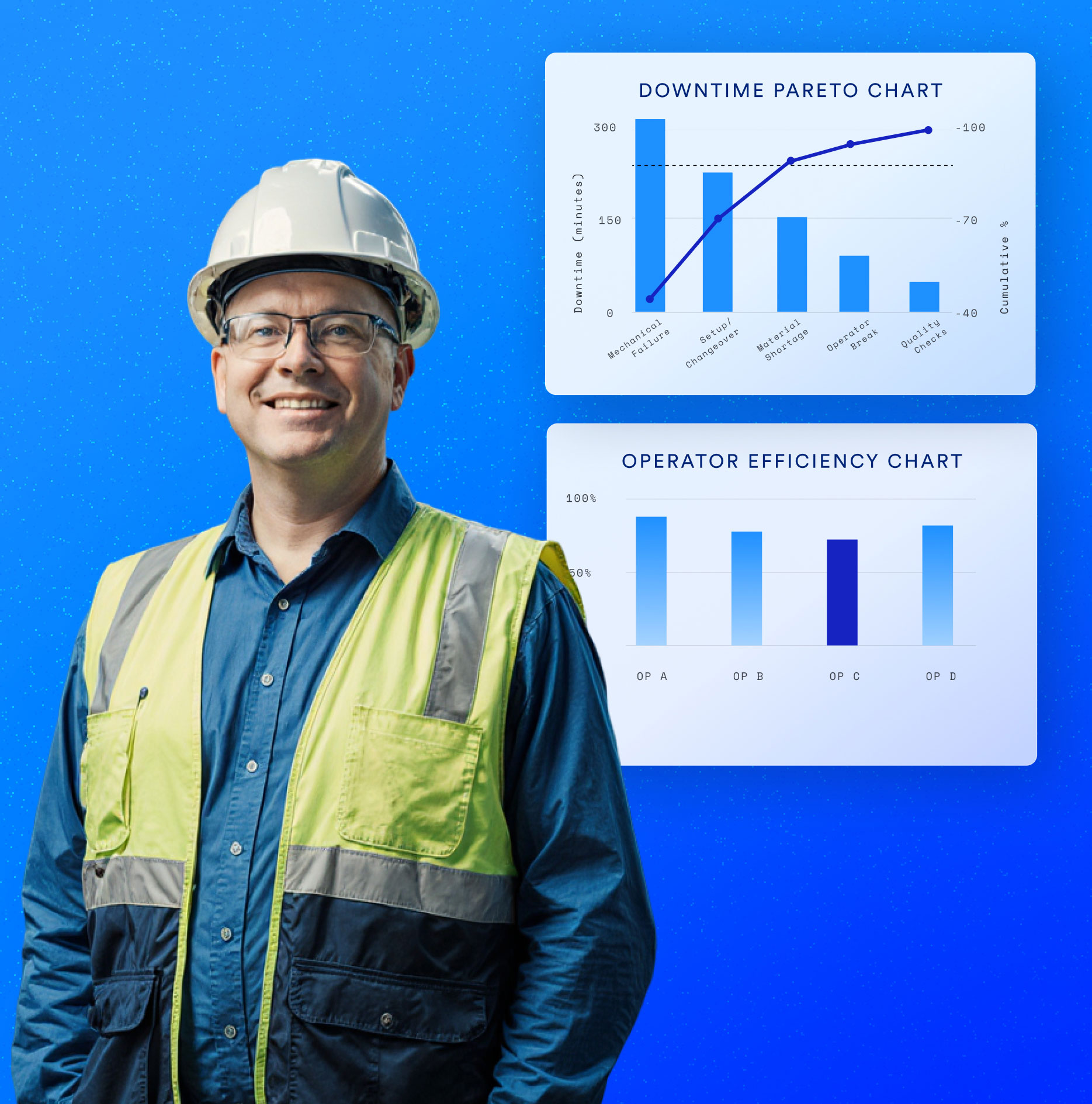
How TrakSYS automates OEE calculation
This is where a Manufacturing Execution System earns its place in the stack. Parsec describes the TrakSYS approach to OEE in one sentence:
“TrakSYS provides concurrent, real-time calculations of availability, performance, and quality to improve production OEE.” — Parsec Automation
In practice, that means TrakSYS reads machine state directly from PLCs, drives, scales, vision systems, and the SCADA layer — typically through Kepware KEPServerEX as the OPC abstraction — and applies the OEE formulas continuously, per equipment, per product, per shift, per operator. None of the five manual-calculation pitfalls above can survive that architecture:
- Planned vs unplanned downtime: equipment-state changes are captured in milliseconds with timestamps. The downtime reason is selected by the operator or automatically inferred from the PLC tag — but the classification is deterministic and consistent across shifts.
- Counting product, not parts: TrakSYS knows the recipe and the cavity count. Performance is computed against the correct theoretical part rate, not the cycle rate.
- Micro-stoppages: a 30-second jam shows up as a 30-second downtime event automatically. The operator doesn’t need to log it; the PLC already told TrakSYS the line stopped.
- Quality at every station: reject signals at any inline inspection point — vision, scales, checkweighers, X-ray — feed Quality in real time. Rework events are captured separately from first-pass yield.
- Latency: the OEE dashboard updates continuously. A line supervisor on the floor sees their shift OEE in real time, not the next morning. A plant manager in Singapore sees the same numbers from a Vietnamese site over the same dashboard.
For plants in regulated industries — pharma, biologics, F&B with HACCP, automotive Tier 1 — TrakSYS additionally generates the audit trail that customer and regulator auditors expect. The OEE data is signed, timestamped, and locked against post-hoc edits.
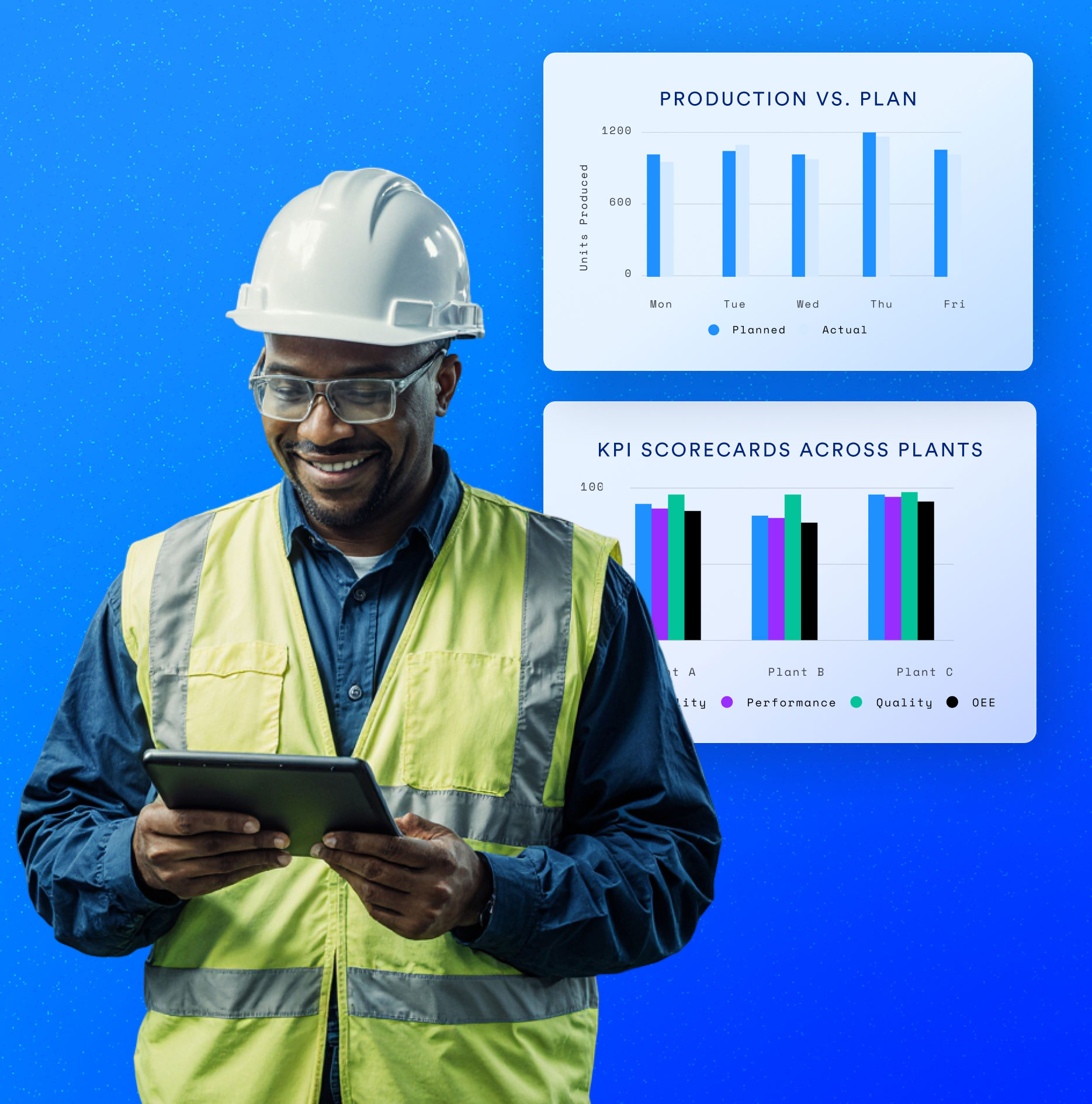
The business case: AstraZeneca’s 40% OEE improvement
Parsec publishes one of the cleanest customer references in the MES market. From the company’s own materials:
“AstraZeneca used TrakSYS to improve OEE by up to 40%, produce over 1 million additional bottles per year.” — Parsec Automation
A 40% improvement is not typical — that is a best-case figure on a line that started with a lot of unrecorded loss. But the underlying mechanic is real: when you make the loss visible, the loss starts to shrink, because the same operations team that couldn’t see it before can now target it directly. The first 12 months of an OEE-focused MES deployment routinely deliver 5-15 percentage points of OEE improvement, paying back the deployment cost faster than any other component of the digital manufacturing stack.
Implementation roadmap for Singapore & Vietnam plants
Based on our deployment experience as Parsec’s authorised distributor for Singapore, Malaysia, and Vietnam, this is the phased rollout we recommend for plants starting an OEE programme:
Phase 1: Pilot line (8-12 weeks)
Pick one production line — ideally one with known performance problems and an engaged line supervisor. Deploy TrakSYS for OEE + downtime tracking only. Connect to existing PLCs via Kepware KEPServerEX. Train operators on the downtime reason-code menu. Baseline the first month, then start a weekly OEE review. Parsec puts typical TrakSYS go-live at “often in 90 days or less” — our regional projects routinely land inside that window.
Phase 2: Plant-wide OEE (3-6 months)
Replicate the Phase 1 configuration to every production line in the plant. Standardise downtime reason codes across lines. Begin daily OEE huddles by line, shift, and product family. By the end of Phase 2, the plant has a single, comparable OEE number that everyone trusts.
Phase 3: Quality + batch integration (4-8 months)
Add Statistical Process Control (SPC), quality events, and — for regulated industries — electronic batch records (EBR). Integrate with LIMS where applicable. For F&B and pharma plants in Singapore and Vietnam, this is the phase where the deployment pays for itself many times over.
Phase 4: Multi-site rollout (6-12 months)
Once Phase 3 is stable at the pilot site, replicate to sister plants. A Singapore regional HQ plant with TrakSYS in production can typically commission a sister site in Vietnam or Malaysia in 8-12 weeks, using the standardised model from the HQ deployment.
The total elapsed time from kickoff to plant-wide, multi-site OEE on a single platform is typically 12-24 months — fast by MES standards, slow by spreadsheet standards. The trade-off is that what you get at the end is durable: an OEE measurement system that survives shift turnover, operator changes, and the next ERP migration.
Frequently asked questions about OEE
What is a good OEE for a Singapore or Vietnam factory?
Per Parsec’s published benchmarks, world-class OEE is around 85% and typical manufacturing sits around 60%. For most SEA plants starting an OEE programme, getting from an honest 55-60% to a sustained 70-75% inside 18 months is a realistic target. Pushing past 80% requires deeper investment in equipment reliability, changeover engineering, and SPC.
Can I calculate OEE in Excel?
Yes — for a single line, for a few weeks, as a proof of concept. As soon as you need multi-line, multi-shift, multi-plant comparability, the manual-entry latency and reason-code inconsistencies break the data. Plants typically move from Excel to MES within 6-12 months of starting a serious OEE programme.
Does TrakSYS work with our existing PLCs and SCADA?
Yes. TrakSYS reads from any OPC UA-compliant source. Our standard SEA integration pattern uses Kepware KEPServerEX in front of the PLCs (Allen-Bradley, Siemens, Mitsubishi, Yokogawa, Omron) and reads SCADA data from Proficy HMI/SCADA, AVEVA InTouch, Inductive Automation Ignition, FactoryTalk View, or any other OPC-compliant SCADA. See our Kepware vs Matrikon OPC server comparison for the connectivity layer.
How long does an OEE deployment take in Vietnam or Singapore?
A first-line OEE deployment is typically 8-12 weeks from kickoff to go-live. Plant-wide OEE follows in 3-6 months. Multi-site rollout adds 6-12 months. Parsec’s “often in 90 days or less” figure is consistent with what we see in the region.
How does OEE relate to TPM and lean manufacturing?
OEE is the headline metric of Total Productive Maintenance (TPM) and is also the standard productivity KPI in lean manufacturing programmes. The three sub-factors map naturally to the lean “eight wastes” framework: Availability captures waiting and motion losses, Performance captures over-processing and underutilised talent, Quality captures defects and rework.
What other manufacturing KPIs should we track alongside OEE?
Mean Time Between Failures (MTBF), Mean Time To Repair (MTTR), First-Pass Yield (FPY), Schedule Adherence, and Throughput. TrakSYS calculates all of these from the same equipment-state and quality data feed that drives OEE — once the OEE plumbing is in place, the rest is configuration.
Next steps
If you are starting an OEE programme — or trying to fix one that has gone stale in Excel — the right next step is a 30-minute scoping conversation. We can review your existing PLC, SCADA, and historian stack, identify the one line where OEE measurement would be highest-leverage, and propose a Phase 1 pilot.
For deeper reading on TrakSYS specifically, see our pillar guide: TrakSYS — A Buyer’s Guide to Parsec’s MES Platform for SEA Manufacturers. For the connectivity layer that feeds OEE data into the MES, see our Kepware industrial connectivity guide. For the cybersecurity overlay any regulated plant needs around its MES, see our OT Cybersecurity Guide for Singapore, Malaysia & Vietnam.
Contact the team at the office nearest you:
Allied Solutions Global is an authorised Parsec distributor for Singapore, Malaysia, Vietnam, and the broader Southeast Asia region. TrakSYS is a registered trademark of Parsec Automation, LLC. The OEE formula definitions and benchmark figures quoted in this article are reproduced from Parsec’s publicly published OEE primer at parsec-corp.com/blog/what-is-oee-in-manufacturing. Product images are courtesy of Parsec Automation and used in the context of authorised-distributor promotion.


